Saturday, 30 May 2015
Blog Entry - Final Entry - Feedback after Demonstration
After completing the 'Director's pitch' (we showed the six songs that we as a group have composed using all the information and techniques we have learnt so far), the feedback received was largely positive.
With Influences from - Laura Marling
'Devil in You'
'The Reason'
'Won't Stand for That!'
'Nameless'
The notable feedback was that giving the songs are all influenced by the same artist, there still remains a great deal of variety - notably in 'Nameless' for it includes a xylophone and a tambourine and 'did not need a drum kit'. The abundant theme of 'heartbreak' (although influenced from Laura Marling) could be a potential drawback as it limits the audience substantially.
With Influences from - Vampire Weekend
'Reappear'
Feedback referenced the fact that the lyrics and topic of the song is intriguing and tells a story - it's not predictable and that is valued in the marketplace.

Blog Entry - Song Writing (album influences)
Regarding song writing the album Chavez Ravine by Ry Cooder, is based on a greater narrative 'It documents in mythical style the disappeared Los Angeles neighborhood of Chavez Ravine, a Mexican-American district that fought over by real etate developers, urban planning activists and city government'. This is an effective way to engage the listener as it is not audience-specific (anyone could find this interesting and enlightening). It gives the audience a taste of a different world, a different culture - taking real events that effected real people and telling the story through music, the listener does not have to relate to the story - just be informed and engaged in it.
A different approach would be that of Laura Marling's album I Cannot Swim, where the theme surrounds love, heartbreak and emotional attachment. With use of metaphors 'Crawled out of the sea, straight into my arms' - adding poetry and evoking more of an emotional response to the audience.
However - on a business level this will limit the audience, as heavily emotional songs are listener specific.
Modern Vampires of the City - Vampire Weekend is an example of a more experimental style
' they trade in Contra's (previous album) bright eclecticism for a less audacious production style and smaller instrumental palette: guitar, organ, help harpsichord' using uncommon/unusual instruments to write music can help open up the target audience - and create interesting memorable songs, that have a strong unique selling point.
Jurek, T. (no date) Chavez Ravine - Ry Cooder | Songs, Reviews, Credits, Awards. Available at: http://www.allmusic.com/album/chavez-ravine-mw0000208854 (Accessed: 29 May 2015)
Phares, H. (no date) Modern Vampires of the City - Vampire Weekend | Songs, Reviews, Credits, Awards. Available at: http://www.allmusic.com/album/modern-vampires-of-the-city-mw0002489977 (Accessed: 30 May 2015)
Friday, 29 May 2015
Blog Entry - Writing Lyrics
When writing lyrics, what are the techniques one can use? What are the most important things to think about when writing lyrics?
During a song writing workshop held by Natalie (vocal tutor), some effective methods were given to us including.
Alliteration - 'artificial amateurs aren't all amazing' - Alphabet Aerobics by Blackilicious , words beginning with the same letter enforce a beat, and are easy to remember. Also they are aesthetically pleasing to the ear.
Emotive Language - 'And I will always love you!' - Whitney Houston,
First Line Techniques - ''If you like Piña Coladas!' - Jimmy Buffet, the first line draws people in, and needs to be a stand alone line that is memorable.
Paragram - Imagery Personification, metaphors, symbolism.
Hyperbole - 'Cry Me a River' - An exaggerated statement not to be taken literally, hyperboles are good for creating different moods and atmospheres.
Rhyme - As has been noticed previously, we like patterns - rhymes can help phrase songs and are usually pleasing to the listener, also rhymes show creativity and care - it can be easier to express an idea by having the rhyme to enhance it.
Assonance - ''the repetition of the sound of a vowel or diphthong in nonrhyming stressed syllables near enough to each other for the echo to be discernible'' Oxford Dictionaries.
Sunday, 24 May 2015
Blog Entry - What does it mean to be a part of the Music Industry?
During the course, an emphasis has been put on the concept of being un-attached to media on a personal level, and being aware of your own part in this whole industry - that fact that we (the common folk) are vulnerable consumers - meaning that as much as many of us consider ourselves to be independent and knowledgeable people, we are essentially slaves to an ongoing cycle of recycled merchandise - and we will buy what they tell us to buy.
An example of this branding being The Sex Pistols, obviously well known - their name being associated with anarchy and rebellion and the fact that they sang with 'working-class accents' helped them to be perceived as 'genuine' and 'relatable' to the masses.
However 40 years later we can see that non-music orientated The Sex Pistols merchandise is commonplace - no longer is it about politics or rebellion or music or anything 'real' - but instead more about the money the industries are getting off middle class teenagers who choose to invest in a
'The Sex Pistols Mug!'.
The proof is all around us, it's not a debatable issue anymore (not that is ever was) - nor is it necessarily and issue per sae. It is merely consumerism and we as the consumers believe we are swearing loyalty to for example The Sex Pistols by investing into these products, but who is actually gaining from this?
It is fair to say that the music industry is a bit fucked up in that respect - as are the other industries that naturally coincide, this mutual dependency between us (the consumers) and them (the big industries) provokes thought in to whether this will ever change - or if people even want a change.
I'm not about to sit here and devise an alternate utopian society - however I will ask the question why do we as musicians strive to become professionals in this industry when we are aware of the twisted mechanics that keep it running?
Saturday, 23 May 2015
Blog Entry - Producers in the Music Industry
As a class we are to take on the responsibility of being our own musical producer for this upcoming project.
So what exactly does a musical producer do? What are the potential problems we could face being our own musical producers? What aspects will prove the most difficult?
A music producer or record producer (not to be confused with an executive producer, who is predominately in charge of the finance side) is essentially the overseer of the musical creation process.
Phil Ek (a noted American record producer) describes his role as "the person who creatively guides or directs the process of making a record, like a director would a movie.' ''Interview with Phil Ek'' HitQuarters. 25 May 2009.
So we, as a unit (taking the role of a record producer) have the task to present our product (a song/s) to an executive producer - in this case the executive producer is our tutor.
Each of us are to present a brief demonstration of our own composition to the rest of the group, and based on the criteria listed below, we will then holistically judge them out of a total of 30.
The Criteria is as follows - (Each question is marked out of ten).
- How well does it respond to the brief?
This is important, as the composition should be taking inspiration from three albums we were assigned to listen to - Ry Cooder Chavez Ravine, Laura Marling and Vampire Weekend.
- Is this non person specific?
This is crucial - if the technical requirements of the song is only suited for one extremely specialist musician, this limits the capabilities that the song will have as a commercial product.
- Is it performable?
This essentially means can the song be recognised as a stand alone piece? Is it still recognisable if played on both solo guitar and piano, or simply acapella? This is a good indication of how strong the song is as any 'hit' song can be extracted to the bare minimum and still be as effective and recognisable to the audience.
It is also important to note that 'personal preferences' should generally be avoided, as we are not trying to make friends with this task, we should instead be judging them as professional producers.
Friday, 22 May 2015
Blog Entry - Clave Rhythms
Following Tim's (Drumming Tutor) Clave Rhythm Workshop - in which we as a group performed independent rhythm sections that layered over one another to form several clave rhythms.
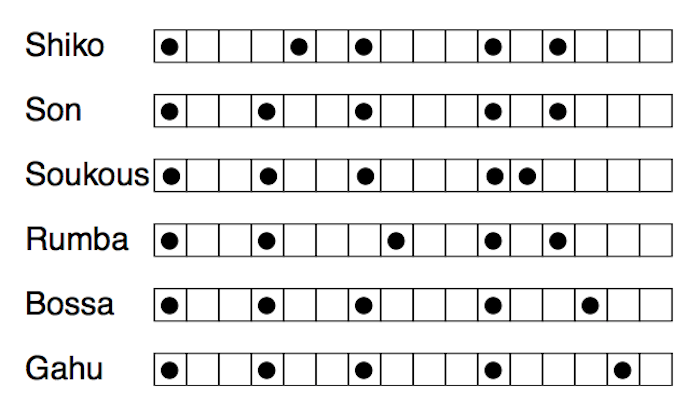 |
| Above is a simplified diagram showing several Clave Rhythms |
Traditional instruments for clave rhythms include -
Top Register - Shakers, maracas, tambourine, guiro.
Middle Register - Claves, Bells, Cowbell, wood bells,
Bottom - Congos, bongos, toms, bassdrum.
It seems clave rhythms are an effective way to add a strong sense of pulse, and rhythmic interest to a composition, this is due to the syncopation and emphasis of off-beats.
'Chinito Chinito' by Ry Cooder from the album Chavez Ravine utilises the clave rhythm, emphasising the Latin-American feel.
Tim has also advised us to modify EQ levels of songs to pick out individual rhythms easier.
Blog Entry - Composition - Getting Started
What are the Primary Components to any Good Song?
When composing, I would say it is important to understand what exactly makes a piece of music good - So what is good? Is that even the right word to use? Should we all be aiming for perfection or excellence? how do we decipher an excellent musical piece from a not-so-excellent one?
Well, as a basis for Western music (both classical and folk, old and modern), patterns, repetition and a balance between familiarity and the unknown are favoured - the concept of a 'groove' or 'pulse' is essentially what we as humans look for in music - as well as an emotional, and psychical response (this could be getting up and dancing uncontrollably, or simply feeling elated or depressed).
Music it seems, is a form of language that is universally understood - often being able to express the inexpressible - so where should one begin when composing?
Melody Writing
Arguably, the melody is the most distinctive feature of any piece of music - chord structures are recycled as are bass lines and rhythms, but it seems melodies are the equivalent of the unique selling point.
Simplicity - Keeping melodies simplistic and paced is important, consumers (listeners/buyers) will be more likely to sing along and have a connection with the music if they themselves can understand it and replicate it.
Repetition - Repetition is key to us as humans recognising patterns - having a consistent theme or a repeated chorus is an effective technique that makes a piece of music memorable.
People often only remember choruses of songs or a certain repeated phrase.
Balance/symmetry - This can be interpreted in different ways, a prominent example of balance in a melody is the main motif of 'Fur Elise'. The melody wants to be resolved. Holding and releasing tension adds movement and a story to a melody.
Movement through Whole Step - The best melodies move mainly by whole or half step note values, Noel Gallagher has notably introduced chromaticism (use of the semi-tone scale) to popular music.
Subscribe to:
Posts (Atom)